
Institute for Military Learning Systems
The Institute for Military Learning Systems (IMLS) is the SAF/SAFTI MI centre of excellence to: a. Drives the SAF’s learning efforts, b. Be the thought-leader for military learning systems, and c. Shape the SAF learning landscape (people, processes and content).
Last updated on 15 October 2026
About IMLS
The Institute for Military Learning Systems (IMLS) was inaugurated on 1 April 2026 through the restructuring of Institute for Military Learning (IML) and Centre for Learning Systems (CLS) to drive learning excellence and develop new learning capabilities for the SAF.
Established as the SAF/SAFTI MI's centre of excellence for military learning systems, IMLS develops competent, confident, and committed instructors, training developers, and training leaders. It drives innovation across the SAF's learning ecosystem by integrating learning sciences, technological enablers, analytics and immersive learning solutions. Together, these efforts will ensure that the SAF remains equipped with effective, future-ready learning capabilities that strengthen operational readiness and mission success.
Leadership message

“SAF learning is defined as a strategic transformation aimed at creating ‘Thinking Warriors’ within a ‘Learning SAF’ to acquire new skills and knowledge. A ‘Learning SAF’ harnesses collective knowledge from exercises and operations to create new insights. ‘Thinking Warriors’ are individuals and teams with the cognitive abilities to sense-make, innovate and adapt to challenges.
At IMLS, we are dedicated to supporting our SAF leaders’ development to keep pace with their professional progress. We have built progressive learning frameworks and systems that do more than just prepare; they mentor the next generation. By weaving specialised adult training concepts directly into our profession's trajectories, we ensure that our junior SAF leaders are not only effective leaders in their respective fields but also holders of qualified accreditations that meet the national standards.
As we look towards 2040, we are reshaping our learning initiatives and systems development. We are moving toward a future defined by a culture of military learning anchored on Andragogy principles, Instructional efficacies and Mentorship characteristics. We will move beyond classrooms to make learning a core part of how we grow. We will adopt smarter systems design, using data to tailor our military learning to advance our people. We will embrace a continuous- improvement approach by refining our excellence competencies iteratively so that we never stand still.
Ultimately, military learning is about our people. We are developing adaptive, mission-ready leaders who can thrive in a world that is becoming more volatile and technologically advanced by the day.”
Dr Pang Chee Kong
Dean IMLS
Organisation and Structure
Organisation and Structure
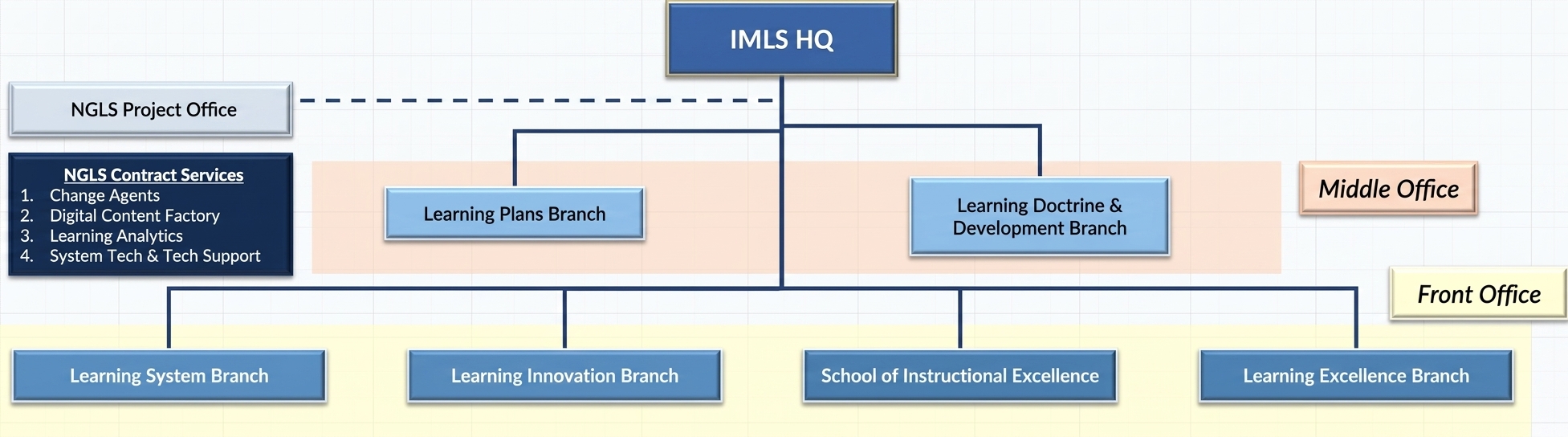
Led by IMLS HQ, IMLS will spearhead the master-planning of SAF learning transformation efforts and provide leadership and oversight for the development and integration across SAF learning initiatives.
Learning Plans Branch drives Capability Development in the Learning Domain; analysing future learning needs across SAF and masterplans the learning transformation; serving as the Learning and Training Development & Instruction (TD&I) Domain authority; and coordinating the roll-out of new learning initiatives and driving learning change management across Services. The branch is also the secretariat for learning transformation initiatives, ensuring efforts across entities remain aligned and sustained while managing resources to scale enterprise-based learning systems and T&L Domain digitalisation plans.
Learning Doctrine and Development Branch is the authority for learning design and trainer development; establishing and sustaining learning doctrines to govern design and delivery of individual and collective-based learning as well as the competency framework and development roadmaps for the SAF training community.
Learning System Branch plans and develops the learning enterprise system; integrating technologies with curriculum and workplace practices; and supporting in the implementation of learning technologies. LSB oversees the administration, maintenance, governance and sustaining of the operations and life-cycle of enterprise learning systems.
Learning Innovation Branch is the executive arm to develop and validate new learning solutions to support SAF’s learning transformation through a learning engineering approach that integrates learning science, technology, and data analytics. LIB translates emerging practices from academia, industry, and other organisations into contextual solutions through iterative experimentation with internal stakeholders. An in-house immersive-based lab enables rapid prototyping and iteration of learning products such as immersive content and artificial intelligence programmes, allowing concepts to be tested prior to scaling.
School of Instructional Excellence conducts the SAF instructors’ development courses and provides certified/ accredited programmes, training courses and continued professional development for the SAF Training Development practitioners.
Learning Excellence Branch advances TD&I's organisational excellence by driving the implementation of the updated Training Institute Excellence Model (TIEM) across the SAF Training Hub. It also develops and maintains SAF-wide learning evaluation and course validation standards, and validates course curricula to ensure the quality, consistency and effectiveness of training and learning.
Contact us
Institute for Military Learning Systems
📍 500 Upper Jurong Road
Blk 77 Level 2
Singapore 638364
☎ +65 6799 7361